Corporate giving
 Sponsorship
 Legacy giving
 Donate most needed food
 First Responders to Food Bank 365
 EAT 365
 Host a food and fund drive
 Volunteer
 Events
 Advocate
 Mobile Pantry
 Food Recovery program
 Feed Collaboration
 Fresh Approaches Food Centre
 Perishable hamper line
 Community Food Assistance Network
 Our team
 Community Food Assistance Network
 Plans and reports
 Careers
The Food Bank of Waterloo Region’s Community Impact report shows 1 in 10 households relies on hamper program for food
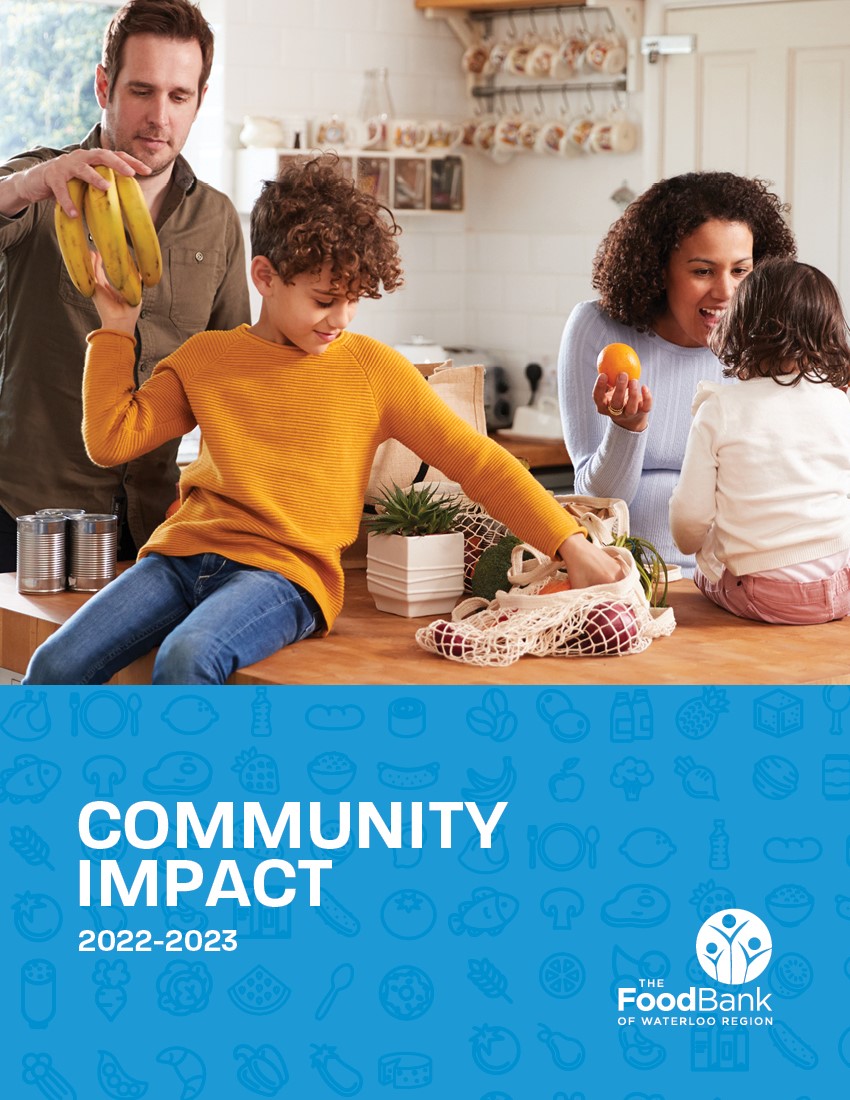 Waterloo Region, Ont., November 23, 2023 – The Food Bank of Waterloo Region released its 2022–2023 Community Impact report today, showing that more than 58,600 adults, children, and seniors accessed food assistance this year, visiting more than 450,300 times—an 45 per cent and 31 per cent increase respectively over the previous year.
The report, which shares data collected between July 1, 2022 and June 30, 2023, also shows that one in 10 households is struggling to afford to put food on the table. A year earlier, that number was one in 14 and two years ago, one in 20 households.
There was also a significant increase in the number of new households accessing food assistance in Waterloo region. This surge in demand for food support, with 7,549 households seeking assistance compared to 3,500 the previous year, represents a 113 per cent increase.
“These startling numbers not only tell us that there’s a growing need for food assistance in our community, but also suggest that the escalating cost of living is placing individuals and families in a challenging situation, compelling them to make impossible choices such as prioritizing rent or mortgage payments, fueling their vehicles for work, and providing meals for their households,” says Kim Wilhelm, interim CEO, The Food Bank of Waterloo Region.
The report also shows that 11 per cent of households accessing a food assistance program in Waterloo region reported they had a job but not enough income to buy food. Twenty-one per cent of households accessing local food support services reported they receive Ontario Works or Ontario Disability Support Program payments but didn’t have enough money left over for groceries. Similarly, another three per cent of households accessing a food assistance program reported they rely on Old Age Security payments but didn’t have enough room in their budget to cover the cost of food.
“When over 30 per cent of the people in need of food support are employed or receiving some type of government assistance and still can’t afford to eat, we’re no longer a source of temporary emergency assistance in times of crisis—food banks are becoming the norm when they shouldn’t be,” Wilhelm says.
She adds, “It’s clear that something must change. Food insecurity is a complex issue and food banks alone are not the solution. To address the root of food insecurity, we need meaningful engagement and action from all levels of government. We need strong public policies on social assistance, living wages, and affordable housing to improve the incomes of those living in food-insecure households.”
In the meantime, with the community’s support, Wilhelm says The Food Bank will continue to ensure that people in Waterloo region have access to the food they need.
In 2022/2023, The Food Bank acquired and distributed 7.2 million pounds of fresh, frozen, and non-perishable food to both the Community Food Assistance Network and provincial partners through the Food Bank Distribution Services (FBDS) program.
The Network is a system of more than 120 agencies and community programs in Waterloo region working together to provide food, support, and services to people in need. Whereas the FBDS program, coordinated by The Food Bank in partnership with Feed Ontario, redirects surplus food from producers and distributors to smaller food banks and food assistance providers across southwestern Ontario that are FBDS program members.
“Our community’s support in helping neighbours facing hunger is invaluable,” says Wilhelm. “Without the generosity of cash and food donations, we would be unable to restock our inventory, buy food to meet diverse cultural and dietary needs, keep our delivery vehicles on the road, or sustain the Network. And without the more than 3,800 dedicated volunteers who support our operations, we would be unable to do the important work of ensuring no one in our community goes hungry.”
With food support from The Food Bank, the Network distributed 151,000 food hampers to hungry people in the community, up 33 per cent from the 114,000 hampers distributed in 2022. The Network also served 874,000 community meals which is a 29 per cent increase over the 675,000 meals served last year.
“We want people to know that asking for help, especially for food, carries no shame. Our Network partners are here to provide food and we encourage people to reach out for help and contact our Centralized Food Assistance Outreach line at 519-743-5576 extension 340 if they need support,” says Wilhelm.
To learn more about how you can make a difference in the community, visit thefoodbank.ca/get-involved. To read the full 2022–2023 Community Impact report, visit thefoodbank.ca/about/financial-accountability/.
About The Food Bank of Waterloo Region
Founded in 1984, The Food Bank of Waterloo Region (The Food Bank) was the first organization of its kind in Ontario dedicated to providing emergency food. Thirty-nine years later, The Food Bank continues to evolve to meet the needs of the community, ensuring no one goes hungry. Each year, The Food Bank acquires and distributes more than five million pounds of fresh, frozen, and non-perishable food to 120+ community programs and agency partners throughout Waterloo region. Learn more at thefoodbank.ca.
Follow/like us on social
#FeedWR
Facebook, Twitter, Instagram, Threads, Pinterest: @FoodBankWatReg
LinkedIn/YouTube: @FoodBankWaterlooRegion
Media contact
Michelle Rickard
Manager, Marketing and Communications
The Food Bank of Waterloo Region
micheller@thefoodbank.ca
Join the conversation
Share this media release on social media!