Corporate giving
 Sponsorship
 Legacy giving
 Donate most needed food
 First Responders to Food Bank 365
 EAT 365
 Host a food and fund drive
 Volunteer
 Events
 Advocate
 Mobile Pantry
 Food Recovery program
 Feed Collaboration
 Fresh Approaches Food Centre
 Perishable hamper line
 Community Food Assistance Network
 Our team
 Community Food Assistance Network
 Plans and reports
 Careers
Anishnabeg Outreach is an Indigenous-led non-profit and registered charity dedicated to supporting First Nations, Inuit, and Métis individuals and families. Grounded in culture, connection, and community, the organization offers mental health support, employment services, and meaningful cultural programs—from beading circles to ribbon skirt and shirt workshops.
The organization also operates two Centres for Reconciliation in Kitchener and Guelph, creating welcoming spaces for healing and learning.
Addressing food insecurity: The Spirt Bundle program
With support from The Food Bank of Waterloo Region, Anishnabeg Outreach helps address food insecurity through its Spirit Bundle program, providing food hampers to First Nations, Inuit, and Métis individuals and families in need. Hampers are available at three pickup locations:
- Kitchener: Tuesdays and Thursdays from 9 a.m. to 3 p.m.
- Cambridge: Every other Tuesday from 11 a.m. to 1:30 p.m.
- Guelph: Every other Thursday from 10 a.m. to 3 p.m.
Indigenous community members can access the program twice a month, receiving a variety of fresh, frozen, and non-perishable food—including items from The Food Bank and produce grown on Anishnabeg Outreach’s Spirit Garden, a 17-acre farm in Breslau where nourishing food and traditional medicines are cultivated.
“Every participant has unique dietary needs and almost every family is different,” explains Stephen Jackson, the CEO of Anishnabeg Outreach. “When we deliver reconciliation, we avoid doing things ‘to’ or ‘for’ Indigenous people. We believe reconciliation will only be achieved when it is done ‘with’ Indigenous people. The Spirit Bundle program emulates this philosophy. This means that every order is custom designed to meet the requested needs of each of our program participants.”
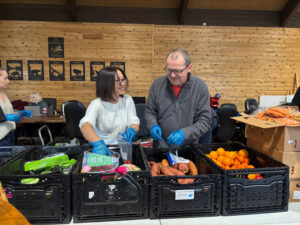
Staff and volunteers packing food hampers.
More than food: supporting families holistically
The Spirit Bundle program goes beyond food. Participants can also receive cleaning supplies, toiletries, pet care essentials, clothing, and seasonal items for back-to-school, Halloween, or Christmas celebrations.
“We even include cultural supports like beading kits and traditional medicines—such as sweetgrass and sage—grown at our reconciliation farm to help strengthen cultural identity and belonging,” says Stephen.
This holistic approach reflects the connection between food security and mental health.
“We believe that mental health and food insecurity are deeply intersected,” Stephen shares. “Our partnership with The Food Bank of Waterloo Region is vital because it allows us to blanket the region’s most vulnerable populations with support that addresses both the physical need for food and the emotional need for healing from intergenerational trauma. We are forever grateful for the support of The Food Bank.”
Growth, challenges, and community impact
The Spirit Bundle program has grown significantly—from supporting 20 families at the start of the pandemic to over 600 households currently registered.
“While our distribution operates on a bi-weekly schedule and not every registered family picks up food during every cycle, the fact that we have over 600 families on our registry highlights the immense and ongoing demand for culturally safe food,” Stephen notes.
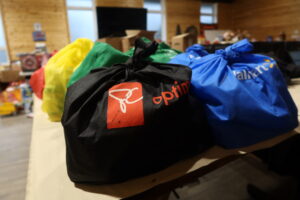
Packed hampers.
Beyond meeting immediate food needs, the program often serves as an entry point for building relationships and connecting families with other supports.
“Many families initially come for a Spirit Bundle and eventually feel safe enough to access our healing and employment services, leading to long-term self-sufficiency,” Stephen explains.
The program also strengthens emotional well-being, cultural connection, and community belonging.
“Beyond immediate food security, the program reduces isolation and strengthens cultural identity. Our participants have shared that the program is ‘essential’ and that the inclusion of items such as toys or beading kits is ‘calming to the spirit,’ helping them feel respected and heard. We know this program provides dignity and hope,” Stephen says.
He adds, “We started this program to help Indigenous people survive the pandemic and to give Anishnabeg Outreach time to develop our other resources like mental health and employment support. We have completed the development of our resources and have begun partnerships that will help us deliver reconciliation-based outcomes. We are hoping this will mean Indigenous people we are helping will need less food support in the future.”
Anishnabeg Outreach is one of 61 organizations in the Community Food Assistance Network. If you’d like to help The Food Bank support Network partners like Anishnabeg Outreach, visit our Get Involved section on our website to learn more about donating food, funds, or time.
Join the conversation
Share this spotlight on social media!