Corporate giving
 Sponsorship
 Legacy giving
 In memoriam
 Donate most needed food
 First Responders to Food Bank 365
 EAT 365
 Ways to give
 Host a food and fund drive
 Volunteer
 Events
 Advocate
 Get involved
 Mobile Pantry
 Food Recovery program
 Feed Collaboration
 Fresh Approaches Food Centre
 Perishable hamper line
 Our team
 Community Food Assistance Network
 Plans and reports
 Careers
Indwell creates affordable housing communities throughout southern Ontario, providing people with a foundation for health, wellness, and belonging. Through community programming, harm reduction services, addiction supports, and other health-focused initiatives, the organization helps tenants build stability and independence while creating opportunities to thrive.
“Our focus is to build affordable, good-quality housing communities for those that are seeking health, wellness, and belonging,” explains Leah Logan, Indwell’s regional director for Waterloo and Halton regions. “We are the developer, the property manager, and the health provider for individuals living in our housing. Our mission is hope and homes for all. Therefore, we’re really focused on seeing those that struggle to attain housing have access to housing through our programs.”
Indwell operates more than 1,400 housing units across southern Ontario, including five housing programs in Waterloo region. The Food Bank of Waterloo Region provides food support to three of those locations: 140 Weber St. in Kitchener, also known as Weber St. Apartments, Magnolia Apartments in downtown Kitchener, and Robert Kerr Manor in Cambridge.
“In Waterloo region, we’re working to ensure that people experiencing homelessness have housing to move into and the right level of support wrapped around them. In doing so, we know that housing stability can be achieved, and health can be grown as well,” Leah says.
Food delivered close to home
There are 31 housing units at 140 Weber St. and 41 housing units at Magnolia Apartments. Every two weeks, The Food Bank’s Mobile Pantry visits both locations, bringing food support directly to tenants and making it easier to access nutritious food close to home. Tenants can choose from a variety of fresh, frozen, and non-perishable items.
“Food we’ve noticed that people seek out the most are peanut butter, bread, and protein items like tuna and beans,” says Rikki Bouwman, the program manager at 140 Weber St. “Instant coffee is popular as well. Everybody loves coffee at our programs. [The Mobile Pantry] is always appreciated by this community regardless of what they receive.”
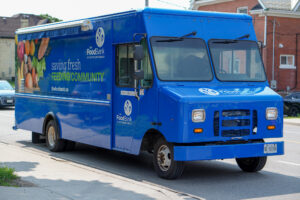
The Mobile Pantry.
More than a food hamper
For Rikki, the impact of the Mobile Pantry extends far beyond food. The visits create opportunities for tenants to leave their apartments, connect with neighbours, and spend time outdoors. They also encourage routine and responsibility, as tenants plan their schedules around the Mobile Pantry’s arrival. Some tenants even volunteer to help distribute food.
“People are reaching out to staff to say, ‘Hey, I have an appointment, but I really want to prioritize my health. Can you grab me a food hamper?’” Rikki says. “You see tenants grabbing food for their peers, being a good neighbour. You see volunteers packing bags to bring to someone they know is struggling with their mental health and can’t leave their apartment but still needs access to basic necessities. You see people hanging outside [the Mobile Pantry], creating community. They’re spending time with their peers and getting out in the sun, instead of navigating isolation alone. It’s been really beautiful to see.”
By bringing food directly to where people live, the Mobile Pantry removes barriers while creating opportunities for connection, independence, and personal wellness.
“Bringing food to people’s doorsteps and eliminating that barrier to access has just created more opportunities for our tenants to engage in their own wellness,” Rikki shares. “[The Mobile Pantry] is giving our tenants the ability to have a choice. To have some autonomy, nutrition, and grow community.”
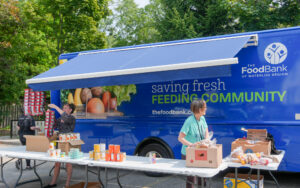
Volunteers putting food on tables for tenants.
Breaking bread together
Any extra food at the end of the Mobile Pantry’s visit is used to make community meals, bringing tenants together over shared breakfasts and dinners. Extra food is also used to teach tenants how to cook, prepare healthy meals, and build confidence in the kitchen.
“We all sit down and we break bread together,” Rikki says. “We’ve done cereal programming on the weekend now because we’ve been able to sustain having milk regularly. Or toast, so we can all sit down and make some toast and watch some cartoons with our coffees and talk and socialize.”
Leah says the impact of reliable access to food can be seen in both the physical and emotional well-being of residents.
“For me, what is the most beautiful thing to witness coming out of this program would be wellness,” Leah shares. “Housing and food, addressing those basic needs, allow people to thrive in their other social determinants of health. I’ve had the privilege of witnessing that growth of tenants’ wellness because of the access that they have to their basic needs.”
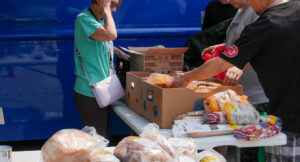
Tenants choosing food items.
Building skills and community
At Robert Kerr Manor, a 45-unit housing program in Cambridge, tenants don’t receive visits from the Mobile Pantry but still benefit from food provided by The Food Bank. Residents can access food through an onsite pantry, which is also regularly used in community meals and educational programming.
“We host a food pantry day where people can come and access food,” Leah explains. “We also offer different programs, such as barbecues and breakfasts. With the donations we receive, we can be creative about the type of food club we host each month.”
Those programs often evolve into tenant-led initiatives.
Leah adds, “A tenant might say, ‘I can make a mean pancake with this. Let’s start pancake club, and I’ll teach people how to make pancakes.’ It’s a chance for tenants to build skills while also taking the lead in running programs.”
Similar outcomes are being seen at Magnolia Apartments, where residents access the Mobile Pantry and participate in community meals and skill-building activities that bring tenants together while developing practical life skills.
For Leah, food is about much more than meeting a basic need. It serves as a foundation for learning, connection, and building stronger communities.
“For me, food is deeply intertwined with community, and we see that in all of our programs. It’s not only meeting a basic need and supporting health and wellness, but also fostering a sense of connection and belonging, which is equally important for our tenants,” she shares.
Indwell is one of 61 organizations in the Community Food Assistance Network. If you’d like to help The Food Bank support Network partners like Indwell, visit our Get Involved section on our website to learn more about donating food, funds, or time.
Join the conversation
Share this spotlight on social media!